Sunday, May 1, 2016

Prompt #6

Prompt: In his 1946 essay "Politics and the English Language", Orwell describes the English language by saying: "It becomes ugly and inaccurate because our thoughts are foolish, but the slovenliness of our language makes it easier for us to have foolish thoughts". Using at least three sources from this Conversation, explain whether you believe Orwell's statement is true today.

Language itself grows in complexity with the person; infants speak with slobbering gobbledygook whereas an educated elder generally has a more refined lexicon. However, even with urbane vocabulary, it seems that most of the time, speakers of the English language fail to properly assert their thoughts and emotions accurately. According to Orwell, the issue does not necessarily lie within the man's capability to conjoin the individual jigsaw pieces that form the sentence, but rather is rooted within slipshod nature of the English language itself, saying: "It becomes ugly and inaccurate because our thoughts are foolish, but the slovenliness of our language makes it easier for us to have foolish thoughts."

But before creating bias towards this statement's validity, it's imperative that the reader deconstructs the line to understand Orwell's true claim. Orwell's quotation easily can broken into two independent clauses: "[the English language] becomes ugly and inaccurate because our thoughts are foolish", and "the slovenliness of our language makes it easier for us to have foolish thoughts."

The first bit, "[the English language] becomes ugly and inaccurate because our thoughts are foolish", states that the "ugl[iness]" and inaccura[cies}" of English are derived from the foolish thoughts that a man creates. An example of this would be "name calling"--"giving 'bad names' to those individuals, groups...that [the propagandist] would have [his audience] condemn and reject" (Name Calling 757). In essence, the propagandist can manipulate language to ostracize a certain individual or group by painting them as a inaccurate negative stereotype. And why does he do this then? What does he even accomplish? Well, there is no real reason beyond emotional impulsive action; as Orwell stated, the propagandists' "thoughts" when boiled down to the core are "foolish". However, the improper usage of English is not only limited to negativity, but it can also be used as a show of politeness and civility. Pinker, explores this in his essay, Words Don't Mean What They Mean", by posing a candid epiphany: "Why don't people just say what they mean?" (Pinker 746). He expands of this single thought, explaining that at the dinner table, although you just want the damn salt, you use a "whimperative" and ask if your kind dinner-neighbor if he "could pass the salt" (746). The answer to the question is obvious (yes, your neighbor can pass the damn salt), so it--blatantly--is "foolish". Asking the question is also "inaccurate"; you know very well he can pass the salt.

 The second constituent, "the slovenliness of our language makes it easier for us to have foolish thoughts." On the surface of the language, it is understandable as to why Orwell made such a bold claim. Yes, the English language appears biased toward the male population--words such as "mankind", "hu-man", "wo-man" (The Word Police), and that can be considered "slovenliness" (the creators of the language were too lazy to draw up female counterparts--oh but wait, even fe-male is biased towards males). However, this male dominated language, does properly reflect the nature of society both presently and historically. Masculinity itself is associated with Power, and Strength, and Capibility, whereas delicate, beautiful and docile are traits tied to femininity. 'But Author, isn't it because the English language reflected Men governing that Men fell into power?' Sadly, no, my dear reader. The general public believes that people created communication. So if people created communication as a tool, there isn't any real logical possibility that the language came before Man.

Sunday, April 17, 2016

FEELING SAFE YET? LET'S BUILD A WALL, BECAUSE IF WE CAN'T KEEP THEM OUT, AT LEAST WE CAN KEEP US IN.

PROMPT:
American essayist and social critic H. L. Mencken (1880–1956) wrote, “The average man does not want to be free. He simply wants to be safe.” In a well-written essay, examine the extent to which Mencken’s observation applies to contemporary society, supporting your position with appropriate evidence.


To even begin examining Mencken claim, first two words must be defined: "free", "safe." To be "free" is to be capable of living without obligation towards another existence. On the other hand, to be "safe" is to be capable of living without fear towards another existence. Being "safe" can be in regards towards nature, other nations, social groups or even other individuals. It is for this "want" of safety that man had originally built houses. Those personal shelters that protected him from the calamities of mother earth eventually progressed to groups of homes--entire civilizations--which kept the hims safe from Them. But even within the nation, man didn't feel "safe". So he erected barriers (or fences) to keep his neighbor out.

From the lips of the future president of 2016, "The fact is, since then, many killings, murders, crime, drugs pouring across the border, are money going out and the drugs coming in. And I said we need to build a wall and it has to be built quickly." In this quote President Trump is clearly addressing the safety of the American People. Clearly Trump realizes that Mencken's principle is correct about man naturally "wanting to be safe" instead of "free." Understanding this concept, the candidate embellishes this fear of poisons entering and wealth exiting the U.S. system ( a [h]uge** portion of the candidate's campaign) which effectively gains him multitudes of votes despite his incompetence, immaturity and lack of experiences in any sort of politics.

Jokes aside, realistically speaking, feeling "safe" is ephemeral. It will never last. Now note, "safe" is a feeling, which interestingly enough, is a noun but appears as a gerund. As students of the English language we can all agree that the suffix "-ing" provides motion, existentialism in the moment. Fear will always exist, because no matter how many walls you throw up to divide yourself from the external world, internally your sub-conscience will create paranoia. Because if there were no reason for growth or development, well then, there would be no reason to exist in the first place. Therefore the feeling of comfort and safety contradicts life as a whole.
In retrospect, the inner soul must present these fears in order to live. 


Human is really two existences, symbiotically co-existing as one physical form--

the Soul and the Man.


So yes, the average man chooses this false sense of security, because even though the feeling is momentary, at least he still experiences something aside from the perpetual fear that flows through life. The average man cannot want freedom, because he will always be indebted to the demons inside that breathe out his fears just so he can continue living (which like feeling, is short-lived [oh snap its a pun within a pun {and an aside, within an aside, within another aside #PARATHETICAL-CEPTION}]).


 At the end of the day (or at the end of my life), no matter how much life I live or how hard I try to break away, I really could never be "free", can I? I will always indebted to the monster inside me, 


and I think I'd known that from the start.


Footnote:

**I'm mocking Donald Trump's accent or style of speech, he tends to say "yuuge" instead of huge

Sunday, March 27, 2016

Education vs. Me: What's more important?

This past week in class, we have been examining education and conflicts that arise from it. The first synthesis prompt we were exposed to questioned whether or not religious attire could/should be worn during school hours. The controversy centralized about Aishah Azmi-a muslim teaching assistant-who refused to remove her hijab at the primary school she worked when British officials confronted her due to complaints from her colleagues and the parents of her students.
 In source A of the prompt, the present Prime Minister at the time, Tony Blair, stated that Azmi's failure to remove her hijab denied the "right of the children to a full education." However, the hijab originally served as a symbol of chastity sacrilege, a self-choice regarding personal identity.

 Now, most of the world follows a christian faith, the majority falling in the continent of Europe. In Luke 6:31, Jesus states: "as you wish that others would do to you, do so to them." In simpler terms, give others the respect for who they are so they may return you the respect you deserve. This moral code is part of the "one true moral law" as an absolutist would claim (Walter T. Stace, The concept of morals). 
That being so, it seems ridiculous that by denying Azmi her identity--albeit Muslim, a gentile so to speak--somehow the children are receiving a 'fuller education.' I mean, the purpose of the hijab is to prevent promiscuity, so by enforcing martial law for woman not to cover up, isn't the government insinuating the ideal that women should strip down--possibly as far as nude--for students to learn better? Doesn't that sound like objectifying? Americans want less women in the street as prostitutes, yet somehow we want to have the role models of the nation's youth be skin-clad? I'm confused. 


Referring back to Stace's, The Concept of Morals, absolutism establishes that there is "one moral code," so both of the contradicting sides cannot be correct, right? Being me is already hard enough in America as is. But I'm not going to lie, we've moved pretty far since we started as the thirteen colonies. Just take a look at the 13th, 14th and 19th amendments in the U.S. Constitution, which the supremacy clause deems the Law of the Land. We've done some great things in the past, but we can't settle for less. America's got to strive for more. I hate to say it, but Trump is right, She needs to be great again. And that greatness starts from fixing the small issues. If you hit an oak tree a thousand times in the same spot, it is bound to fall.

Sunday, March 20, 2016


The above political cartoon is a parody of Donald Trump's reality TV show, "Celebrity Apprentice." The only difference is that in this instance it seems that Trump is the employee and Hitler is the Nazi. It's fairly easy to identify the two, as the man on the left has Trump's iconic bleached blonde comb-over and black suit and red tie, while the man on the right sports the classic comb-over and toothbrush mustache combined with the obvious swastika armband. The cartoonist here is quite clearly suggesting that Donald Trump is taking over the position of spreading Adolf Hitler's racist and fascist philosophies, similarly to how an employee would take over a position in a business. It's evident that the seat Hitler is in is larger than the one Trump sits in, also the paperwork is under Hitler, and not to mention the fact that Hitler says, "you're hired"--all of which support a sense of succession or rite of passage. The cartoonist also uses shadowing in her background to foreshadow possible results of Trump becoming president. There are two shadows in the picture, one that falls behind Hitler and one that hangs over Trump. The placement of shadows suggest that the destructive era of Hitler is behind us, but if we allow Trump to become a world leader, we can only expect a re-submergence into chaos and segregation.

Sunday, March 13, 2016

Newton's Cradle

I thought it'd be a fun idea to do the other puzzle paragraph for this week's blogpost, while still attempting to incorporate what we talked about in class this week.

1.  others might say 

2.    

3.    casino 

4.    Lone Ranger 

5.    however 

6.    profiling 

7.    memoir 

8.    Jeannette Walls 

9.    fire
--------------------------
NEWTON'S CRADLE
Knowledge is a perception, examination and transcription, then reanimation within one's memoir of life around him. Knowledge is that slot machine at the casino where it offers a grand prize that covers all the rest of your expenses for life, the slot machine where the chances of winning are slimmer than none--ultimately, taking the little you had left and leaving you better off dead. Since the earliest of days, man has been in search of "knowledge"--the harborer of advancement and destruction. Man can make subjective observations of the life around him, "primitive" and "diverse"(Okefenokee); he can develop intricate and emotional depictions as well--"vast...primeval" and "hellish" (Okefenokee). By the words of Jeannette Walls, "[We] live in a world that at any moment could erupt in fire" (the Glass Castle). Because of this, man seeks knowledge out of fear. However, that knowledge has always been downfall of the greatest minds the world has to offer. Knowledge is man's "liquid sunshine"--a failed and inaccurate replica of the world's generator by the hands of man. The Sun is a public benefactor. It provides energy for nature to operate continuously, however get too close and it will incinerate. In retrospect, knowledge and wisdom play along the same relationship as "liquid sunshine" and the Sun. Wisdom is a complete and accurate profiling of the world, while knowledge is just a cheap knockoff suggestion as to why things happen--and usually knowledge is incorrect. The world isn't flat, radium has no health benefits, and humans are in fact born with proclivities (sorry, Aristotle). So what's the point? Am I telling you to live like the Long Ranger, ignorant of everything that gives you purpose? 
To be honest, I'm not even sure. 
If knowledge is a man's perception of life, and if knowledge  is generally incorrect, and if everyone has a different perspective on knowledge, and if...I don't even know anymore. I mean beyond it being the sole reason for my existence, should I really bother searching for an answer I'll never find? Eh, whatever. I'm just going to leave this here, and live life instead. Not really worth, fussing about--or dying early for. 

Is life to live understanding ephemerally or is it to exist in a perpetual state of falsehood and unknown? Leave a comment below and let me know what you think.

Sunday, March 6, 2016

  1. ;
  2. hot for humility 
  3. everyone
  4. today
  5. haiku
  6. hereafter
  7. :
  8. rhetoric
  9. Gandhi

    Non-violent acts
    Create peace in the now and
    In the hereafter.

    -A Haiku by Daniel Qin

    Today, everyone who advocates non-violence as activism against oppression reference the rhetoric of Mahatma Gandhi: "An eye for an eye makes the whole world blind." Likewise, Martin Luther King Jr. shared similar ideals; Chavez brings up such studies on combating the violence with opened fists throughout his piece time and time again--a belief that he begs that his audience follows. However, the pleas Chavez places at the feet of his readers, seem slightly shallow. In retrospect, acting in non-violence is simple. Nothing is done; only words are exchanged. So if defiance with weapons set aside is such a simple concept, why do nations aim its futuristic artillery and nuclear weaponry at another? Heck--why do children, which Jesus established as the bodies of innocence, still throw stones and pick fights? If those little demons that Jesus deemed as the purest of our race can't even solve conflicts through non-violence, how can Chavez expect the brotherhood to drop its weapons? Instead of asking his audience to engage in the "farmers' movement," Chavez should advocate what nourishes nonviolence--what sort of soil the succulent philosophy must be sowed in. Open fists alone will not shake the hands of enemies, it needs to be accompanied with unfurrowed brows. A man must be hot for humility and without anger for any sort of non-violent actions to truly have effect.

Sunday, February 28, 2016

NEEDS CRITICISM

Here's an email I wrote to a college coach earlier today. I just wanted some criticism on it, anything I really could've done better.
---------------------------------------------------------------------------------------

Hello Coach McMenemy:

My name is Daniel Qin. I am a student-athlete from the class of 2017, playing CM/DCM/ACM (in no particular order); number 79 at the UMich ID camp earlier today. I was wearing a black long-sleeve shirt, white shorts, and white socks. My hair was in a topknot (if you still have trouble matching the name and the face: stereotypical Asian, talked about grades at the end of the camp).

I just wanted to shoot you a friendly email letting you know I am extremely interested in not only studying at the University of Michigan, but--if possible--playing under its amazing coaching staff as well. Beyond winning the Big Bear Trophy against cross-state rival MSU for two years (and running), multiple UMich soccer alumni have been called into not only national team camps, but MLS combines as well. Knowing this--its an undeniable fact that the staff supervising the University of Michigan Men's Soccer Program is among the top in the nation (if not the best). However, the best coaches in the nation--need to bring in players of equal or even greater quality to maintain its greatness, right? Realistically speaking I am not quite up to par with your boys--at this moment. However, I am confident in the near future, I will have what it takes to wear the maize and blue uniform on the pitch with Pride.  

I have big dreams, Coach McMenemy.


Now onto the important "stuff."
I know you just love questions, so here are a few.

1. When we talked, you said that you had wanted to see me play outside of the "ID Camp Environment" and see me active in a more realistic setting. Beyond guest playing for another team, what other possibilities would you suggest?

2. Would attending another one of UMich's soccer camps (I'm talking summer), also help the staff get a better grasp of my personality as a human, ethics as a student, and abilities as a player?
3. I mentioned to you that I was with "Next Level Training" by Aaron Byrd. One of your players, Yamman (also trained with Aaron Byrd), stated that he would likely be back at "Next Level" during this summer. If you get a chance, do you think it'd be possible for you to come to one of the training sessions in that time period, or maybe even one earlier? 

We train at 799 Denison Ct. Bloomfield Hills, Michigan. 
Current Spring Schedule for the next eight weeks (3/3 to 5/1) is:
Thursdays @ 8:00 pm; Saturdays @ 1:00 pm; Sundays @ 1:30 pm

4. Let's assume I decided to play my freshman year at another college solely for college-level in-game experience, a college where I'd play a majority of the games. How would the transfer process look, and could I still stay in touch with you, and how?

Obviously, I still have more questions to ask, however, like most human beings, I don't particularly enjoy answering seven pages of questions on a daily basis, wouldn't you agree?

Thanks again for having me at the ID Camp earlier today. Hope to hear back from you soon.

Sincerely,
Daniel Qin
Troy, Mi (2017)
Next Level Training

---------------------------------------------------------------------------------------
TO MS. VALENTINO: 
Sorry again that this post isn't directed related to anything we did in class this past week. However, I tried to create some comic relief to the serious nature of the email by injecting sarcasm and irony. I also tried to create "voice" in this email, using some colloquial terms like "stuff." 
--------------------------------------------------------------------------------------------------------------------
P.S. ALL RELEVANT INFORMATION OF THE PERSONNEL RELATED TO THIS CLOSED DISCUSSION IS WITHHELD DUE TO LACK OF PERMISSION TO SPEAK OF OR ON BEHALF OF THESE INDIVIDUALS


Sunday, February 21, 2016

Plants+cooking=people?


Junior year is almost over already and I still have no idea what college I would want to go to, nor do I know what I really want to major in. My friends all seem pretty oriented at this point and I honestly feel quite low because of my undecided choices. My friends said I should talk to my counselor. She said, "...in the future You should be doing what You love to do." What do I enjoy doing?* Writing is pretty cool I guess. "Maybe she meant hobbies" is what my friends said.

The study of plants is botany. Botany has been around just as long as there were humans. The very first records of plant-based studies date all the way back to the Neolithic Revolution (at this
point writing had just begun to develop). These rudimentary studies done at that time were driven more by curiosity rather than need or benefit. However, the various health benefits humans know of today could not stay veiled forever. Research done for actual purpose appeared through Theophratus' (student of Aristotle) teachings in Ancient Athens, 350 B.C; most consider this the origin of modern botany.

The study of preparing food are culinary arts. Likewise, the need for food has always been around just as long as there were human. But the very first records of cooking date all the was back to the Middle Paleolithic Era (at this point hearths or stone ovens had just been created). Unlike botany, cooking has always been a luxury, hence the reason it is referred to as the arts. Art  is human expression; beyond defining a man for who he is.

The studies of human interaction is sociology. People have been doing this as soon as they pop out of the womb. The very first records logically would have appeared after Adam and his wife/gal-pal realized they were naked. Sociology is both like botany and culinary arts. To an individual some others are significant, while others appear to be just there. Like botany, a child doesn't realized the need for friends. The child creates relationships out of pure interest. The peer group the kid develops begins defining who he is. Eventually the kid becomes a teen, then a man, and all throughout the process of aging, the boy now adult, realizes friends are in fact like plants and Theopratus was right. He is now matured--a realized demand for and importance of others.

Sociology, culinary arts, and botany all sound pretty awesome to me. Its just too bad that you can't triple major in college. I think I'll just double major in culinary arts and botany--or maybe just music and botany. Eh, I think I'm just going to ask my friends, tomorrow.


*not active reading and Cornell notes


Monday, February 15, 2016


How it Feels to Be Perfect Me

It all started on the day I was born. I was a perfect baby, perfect length, perfect weight, and perfect health. It was then when my parents declared I would become the world’s greatest lawyer, because I was perfect.
When I was four years old, I loved watching Teletubbies, the perfect show for the perfect toddler. My favorite episode was when the kids for hermit crabs. I remember it because it was one of the few full episodes of the show I ever actually watched. Whenever I tried to watch my show, my parents would sit me down and make me endure the presidential debates that were broadcasted on television around the time. Both candidates were idiots. George W. Bush even created a word for the idiotic linguistics he stated on live television, bushism, and Kerry would not stop discussing a war that ended three years ago. If it wasn’t for all the people who had realized the fallacy of having an absolute moron returning to the hot seat, John Kerry probably would have only gotten two votes. These idiots did not compare to Perfect Me, the Perfect Me who could barely add or subtract and had no idea what words such as “unrealistic” and “superstitious” meant.
After another year of dealing with my older siblings’ mistakes and failures, my parents deemed me to become the perfect son. The weight of those words never really struck me until I was eight or nine, but it was alright because I was perfect so I could handle it. At eight years old, Perfect Me could describe the basic skeletal structure of a humanoid and at nine years old, Perfect Me had memorized the multiplication and division table and was reading at a sixth grade level. At eight years old, I would be the last pick for every game at recess due to my size and at nine years I stopped going out for recess and sat inside, surrounding myself with books and knowledge whilst the other children wasted their time smiling, laughing and enjoying childhood. At ten years old, Perfect Me would help out the teacher, grading papers and tutoring other students. Perfect Me was universally sought out for my wisdom by my peers, asking him, “what would be the best way to deal with a friend who I don’t like” and “how should I tell my friend I broke his transformer.” It was almost as if Perfect Me was child Dalai Lama, giving the perfect answer to all the lost sheep in the world. At ten years old, I began to run away from home after my parents whipped me for bring home any grade below an A+. This was perfectly understandable as the perfect son must obtain the perfect grade. Running away from my problems was the perfect solution as well, as you should never voice your opinion and should always avoid confrontation if you want to live the perfect life. I know this because I was born as Perfect Me so I can tell you anything about being perfect.
During middle school, Perfect Me had perfect grades, had found perfect “friends” (who, by the way, were perfect as well, but not as perfect as Perfect Me), Perfect Me had moved into an elite soccer club that travelled the nation, the perfect soccer team. Perfect me was also on the school’s MathCounts first team, placing fourth in regional’s, as well as on team gold for four events in Science Olympiad, winning two first places, one second and one third during the state competition. Perfect Me even became first chair for his violin section for a short period of time.
During middle school, I would be up until midnight. Every day I had to stay after school to finish seventy-five math problems, headed to a speed training and weightlifting class, had a science Olympiad meeting, had violin class or practiced violin, then headed off to soccer practice, before returning home around 10 pm to finish up homework. If I finished my homework early, I would spend the rest of my time before 12 continuing my job as dalai lama for at the time, only a few students. As I laid in bed every night, I was in a cold sweat not only because I was still afraid of the dark, but because I didn’t know what was in it. I could hear the shouts of my classmates asking me for help on a worksheet, my teachers asking me to explain in class how the carbon cycle works, my “friends” consulting me about a conflict with one of their friends and my parents’ statement, “You are going to be our perfect son.”
When I did fall asleep it always started the same. I would have visions of myself in an ash gray suit with a navy blue tie holding a mahogany brown briefcase, standing inches away from a door in a white room. The settings would then change almost like a flipbook, a soccer field would flip by, then a classroom, a cubicle, and even a forensics lab. Regardless of how the order pages would change each night, the last page always remained constant. I was in lying in a chaise longue, still in the ash gray suit with the navy blue tie and gripping a mahogany briefcase. I would look around the room only to realize there weren’t any walls or flooring just jet blackness, only to find a sanguine red spinning chair in front a desk that was cut from a bleeding oak tree. The chair would then swivel, only to reveal a boy wearing an ash grey suit and a blue tie wearing a bauta mask with a pair of thick rusted chains crossing his chest and over the chair. The bauta mask would then fall off, revealing short lengths of black hair hanging over a shattered mirror for a face. Perfect Me would then look at myself in the chaise longue for a few minutes, shrug off the rusted chains, put the bauta mask back on, then walk out door that stayed throughout the settings. I would then wake up shaking with tears in the contours of my eyes, which was then followed by a search for the topography of my nose and my mouth. I wanted to make sure I was still there.


Sunday, February 7, 2016

Sincerity

Let's analyze these passages/scenarios and "dig deeper" in each.


  1.  What behavior (attitude etc.) does the artist want to convey or reveal?
  2. How does the artist clarify the truth of his/her intended purpose?
  3.  What is his/her true opinion?
A) IT is a truth universally acknowledged, that a single man in possession of a good fortune must be in want of a wife. However little known the feelings or views of such a man may be on his first entering a neighborhood, this truth is  so well fixed in the minds of the surrounding families, that he is considered as the rightful property of some one or other of their daughters." ...Jane Austen, Pride and Prejudice


A)  1. behavior: Women are absolutely better than men
      2. clarification: complex sentence structure to show intelligence, capitalization to      emphasize  
      3. true opinion: Austen commentates on definitive societal standards that have established            through American History with extreme intelligence and a foolish truth. 
Sarcasm


B)  1. behavior: people are dogs to the government

      2. clarification: anthropomorphic dog receives orders from government official
      3. true opinion: humans are controlled by the government 


(over-analyze) Satire 


C) 1. behavior: women are silly for trying to step up 
         onto the same platform men exist  
     2. clarification: woman is silent, and submissive 
         just as it God designated
     3. true opinion: men will forever reign as the 
         dominant gender; woman should remain 
         behind or beneath His greatness where she 
         belongs
     Epithet

 D) From The Onion: 2005 Free Response Question 2
But while other insoles have used magnets and reflexology as keys to their appearance of usefulness MagnaSoles go several steps further. According to the product's Web site, "Only MagnaSoles utilize the healing power of crystals to restimulate dead foot cells with vibrational biofeedback...a process similar to that by which medicine makes people better."                                    In addition, MagnaSoles employs a brand-new, cutting-edge form of pseudoscience known as Terranometry, developed specially for Integrated Products by some of the nation's top pseudoscientists.  
D) 1. behavior: This review is complete blasphemy, holding no purpose or meaning whatsoever       2. clarification: The onion is the worst vegetable. Seemingly sweet and bright, in actuality is layered in sharp bitterness and kick which is very well known for making children cry. Similarly, any publication from The Onion is stringent and  exposes others' imperfections to attempt to overshadow its own ineligibility as a substantial provider of viable criticisms                              3. true opinion: (From The Onion POV)- "I am worthless and disgusting. I provide bogus            information to my gullible audience. I am miserable and try to cover my insignificant sugar-      honey-iced-tea with sardonic commentary. I should donate my brain to science. But even if I       did, they'd likely throw it in the composter due to how much waste it's filled with."Sardonic
--------------------------------------------------------------------------------------------------------------Note: This post doesn't state my true beliefs; it was created as a parody to the worksheet given as homework over the weekend

Sunday, January 31, 2016

Expansion on Irony found in Champion of the World

Expansion on Irony found in Champion of the World

Throughout Champion of the World, Angelou utilizes irony to create a realistic perspective regarding treatment toward the Afro-american race in a white society. This chapter of I Know Why the Caged Bird Sings is a retelling of the Brown Bomber's title match through the eyes of a younger Angelou. In her recollection of the fight, one of the radio announcers claims that he "ain't worried 'bout this fight" (Angelou 88). Although this can be taken as a bout of confidence it is in fact the very contrary. Before the Announcer broadcasts this assertion, the author creates a mood of urgency. Angelou writes that every "last inch of space was filled" because not a single person wanted to "miss a word" (Angelou 88). She also follows by describing that children were "perched on every lap available" as if there was no one (babysitters included) to take care of the kids at home--or possibly that this event was so important that parents didn't want their children to miss such a grand event. The setting is also narrated to carry an "apprehensive mood" as a "black sky streaked with lightning" (Angelou 88). By creating a tone of anxiety and uncertainty, it's fair to say that the radio announcer's worry-free nature is anything but comfortable. When in a predicament, it is natural for man to speak some gobbledygook to bolster his confidence: a placebo effect. By recapitulating the desired outcome over and over again, regardless of the likelihood of the actual future, the human mind accepts this proclaimed fate that he covets. At this time period, the majority of the Afro-american race were seen as stupid and weak. Not only that, not one Afro-american had held the WBF Heavyweight Championship Title in twenty-two years. The odds were definitely stacks against Louis' favor. In short, the Announcer is not actually stating that he "ain't worried 'bout this fight" out of confidence, but rather he is trying to rectify or invalidate his own skepticism. What's so important about the inclusion of the Announcer's declaration is the fact that his statement is not only something that belonged to him, but rather belonged to the entire Afro-american race. This inclusion of verbal irony ,that in actuality implies a sense of "apprehension," reflects weakness that the Afro-american experienced in that aeon (Angelou 88). Think about it. Throughout the entire chapter, Angelou refrains from describing all but a few of the tons of characters that congested the shop, as if none of the other characters beyond Angelou herself, Uncle Willie or her friend, Bailey, have an identity in the "Store" (Angelou 88). She even refers to her fellow people as a "crowd" as if one body and no individuality (Angelou 89); and without individual worth, these people have no real value. The words are not of the Announcer's own, but rather a cry of the entire Afro-american race trying to reassure itself that it is not worthless, not only "a little than apes" (Angelou 90). By doing so, Angelou successfully places her audience in the perspective of a black man or woman, clearly depicting the struggles and self-conflict that they had to trudge through as life passed on in a white society.


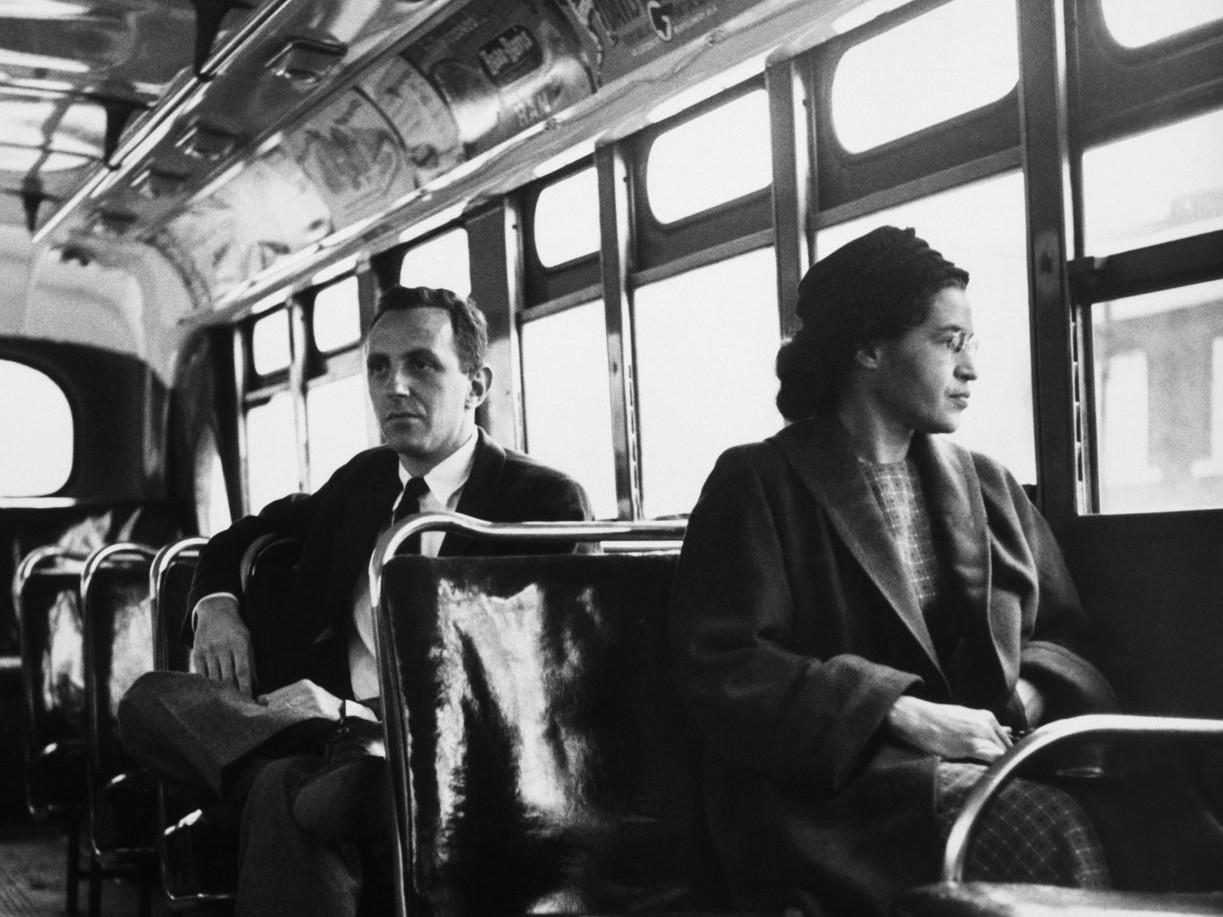
P.S.
Here's a picture of a black man


Here's one of a black woman
Parks on a Montgomery city bus in 1956

(Both photos are left uncredited due to lack of identity)

Sunday, January 10, 2016

I am

I am unstoppable and unreasonable.
I hear iron slamming and heavy breathing,
I see blades of green plastic in a sea of rubber pellets,
I grip an iron bar enwrapped in a rigid surface  in my hands.
I want to become what they told me I could never be.
I am unstoppable and unreasonable.

I pretend only I exist in this singular moment of space and time.
I wonder if this is truly worth the cost, even though they told me not to count it.
I worry this thread of time, holding this anvil of risks and gambles, will snap and plunge atop me.
I cry because every time I get up, I get knocked down on my back
I laugh at this insanity, this cycle of never ending pain--
But I get up.
I am unstoppable and unreasonable.

I understand I am crazy.
I speak of the unfeasible,
I dream the unimaginable,
I hope for one day--one day to be my day.
I reach for something that only my mind’s eye can see.

I am unstoppable and unreasonable.

Sunday, December 13, 2015

Gatsby's Daisy and the Diamond as Big as the Ritz


Foreword

To all the creative minds that scan blogs for interesting and thought provoking ideas and views on humanity and its course, I apologize for this post. My writing is unorganized, my thoughts are unoriginal and my methods are unorthodox--at least that is what I've been told. If after reading this post you want the last three minutes of your life back, I apologize. If you feel the need to murder me solely on the awfulness of this post, please don't do that. I promise I'm a nice guy. 

———————————

The higher I climb, the air seems to thin; it seems breathing becomes more difficult. 

I remember back in elementary school all I ever had to worry about was--nothing really. In the morning, Mom would wake me up at about 8:00 am. She'd then proceed to make me breakfast. I'd whine to her about the scrambled eggs being "overdone" while I sat on my future ACT and SAT textbooks. She'd say sorry. Then she'd drive me to school. There the teachers walked me through new activities: finger painting, counting numbers and reading. The teachers would evoke my imagination and told me to explore myself. They'd read me fairy tales with happy endings; Cinderella kissing her Prince Charming and Snow White riding off into the sunset with hers. The teachers would constantly badger me about how "everything is possible as long as you believe." 

Then came the middle school years, and ooh they were R-O-U-G-H. In the morning, I'd wake up at about 6:40 am and make sure Mom was okay. I'd then proceed to make Mom breakfast, bring it up to her on the foldable table. She'd whisper to me "I love you" and "thank you" while she laid in her recliner bed. I'd close the door and say sorry. Then I'd walk down two blocks to ride the bus to school. There I scribbled notes through my classes: double-advanced math, advanced English, sciences. I would learn to think and see things linearly and I told myself to become someone others liked. I'd read Grimm's fairy tales; the sisters visions' were pecked out by doves and the queen is bound to burning-hot iron shoes until she perishes for trying to maintain her status. I would constantly remind myself about how "at the end of everything is nothing, at the end of beliefs are empty promises."


Everything seems to get worse as we age--especially in America's literature. 
What I read in preschool about the muppets and the friendly purple dinosaur, contrasts largely when compared to books America considers classics, such as "The Bluest Eye" and "The Great Gatsby"; both which examine humans driven into a deep desperation by society. I understand that these pieces are so great because of their critical and true presentation of our evil nature, calling readers to action or at least to attention of needed change in society. But why can't it just be me loving you and you loving me in the first place? And if mistakes happen, why can't we just stop blaming each other and clean up, clean up everywhere with everyone doing his or her share?

I just don't get it. 
Maybe I will when I finally reach to top (if I make it). 


But Daniel, at the top of Everest, everything below you, you've already seen and done and there's nothing but open air around and above you. 


I guess we were right about that then weren't we?

Sunday, December 6, 2015

Delirium

Hey how are you today?
Come and play.
Come in--it's okay.
There's nothing to be afraid of.
Come Inside.
It's beautiful.
There isn't anything quite like it, is there?


Haha.
Hiya red!
How are you doing?
Haha.
No.
Yes.
What.
Shut up.
Please don't stop the music.
Tiny Tim touches Tough Tommy's heart.
Chug-a-chug-a-a-a-achoo!
Bless you.

Haha.Haha.
You see the blue squares rotating?I see nothing!
I think you're a great person. You really should know that.
Haha. Haha.
No. Yes.
What. Shut up.
So back to what I was saying--money makes the world go 'round--
Peter Piper picks a peck of pickled peppers.Does he though?
Spinning.Spinning.
Who are you?The real question is who am I?
In the name of God the father I cleanse you.Be freed


HahaHahaHaha.
It's yellowA bright marigoldIt's mine.
C'mon nowJust relaxHave some fun.
HahaHahaHaha.
NoWhatShutup.
I really do need youWhere are you now that I need youWhere are you now.
Mary had a little lambA little lambA little lamb.
Splish splashSplish splashSplish splash.
Why are you hereWhat did you come forWhy do you do what you do?
I pray Lord that you'd help him seeHelp him unsterstand what I've doneAmen.


HahaHahaHahaHaha
ItsblackItseverywhereItsbeautifulItsdisturbed
HereletmehelpyouBreatheLetgoofthetensionswitinLetmebeincontrol
HahaHahaHahaHaha
NoYesWhatShutup
DontyouknowImlocoInsaneinthemembraneInsaneinthebrainInsaneinthebrain
IloveyouYoulovemeWithagreatbighugandakissfrommetoyouWhywontyousayyoulovemeback
HeavybreathingfearRunquickrunHeavybreathingfearRunquickrun
YouwillstaywontyouYourenotleavinhareyouWhatareyoutryingtodoWhy
AndonthethirddaythesonwillriseagainHewillriseupfromhisgraveHewillriseHewillconquerdeath
C
O
M

E


B


A


C


K


Please.


Dont leave me.

Sunday, November 22, 2015

Bored


WARNING:
This blog post does not follow the general outline of which it must pertain to class. It is a genuine outburst of emotion. Unauthorized reproduction or distribution of this work is illegal. Any found doing so will be found and given justice. Viewer digression is advised.


Do you ever not know what you are doing with your life? Do you ever just sit on your unreasonably large bed considered luxurious for a married couple back in the 1920's, watching a youtube video of cats playing a piano? Are you ever annoyed that the instructions on your dinner require a whopping total of 6 minutes in the microwave? Ever find yourself up at 2 AM trying to figure out what crappy movie to watch next on Netflix?  Have you ever gotten a headache from staring an illuminated screen for too long? Have you ever gotten home at 3 PM, and only until about 9 PM started all the assigned homework in every single one of the six AP classes you decided to take Junior Year? Do you just wish you remembered what you did between 3 PM and 9 PM? Oh wait, didn't you spend 4 out of 6 hours scrolling through your twitter feed? Have you ever even stepped outside to enjoy the beautiful weather? Is life just monotonous and repetitive? Well look no further!/ Prepare to be amazed!/ Well worry no more!/ etc.

We here at BMS Inc. ,Being-A-Millennial-Sucks Incorporated, have something to say:

We do realize that with technology life is much more simple and efficient, however, it seems that our generation really have become bound to technology. Nowadays, when you walk through Somerset Mall, 8 out of 10 people are on a phone, laptop or bluetooth, rather than chatting with their friends, family or coworkers they are with. Nowadays, when you walk down your street on a school-day afternoon, the neighborhood is empty because all of the youth are congregating on multiplayer videogame platforms or internet message boards rather than playing 2 v 2 basketball or soccer. We as a nation have become too dependent technology. Every single household has at least one car. Every single household has a smartphone. Every single household has a microwave. We are becoming these parasitic slugs: slow-moving, obese, privileged, drunken and ignorant. We've stopped enjoying the simple things of life. Rarely do you see a Millennial walking or running to buy groceries from the general store a mile down the street. Rarely do you see a Millennial going to his girlfriend's house to ask her parents if he can take her on a date. Rarely do you see a Millennial taking an hour to cook a nice meal for himself. We've become too dependent on technology. We need our technology as much as we need food, water and sleep. And that's a really scary thought if you really think about it. The religion each one of us grew up with may have been different, but there is one general principle that every religion follows: The God(s) provide. God(s) said that we need four things: food, water, sleep and each other. The Law of Conservation of Energy states that everything in the universe exists in a closed state. Nothing can be produced by nothingness itself, rather it must be derived from another source. So by creating this new necessity, not only are we playing the hands of God(s), we've also taken away the importance of the other four necessities created by The God(s) himself, mainly the need of other. With that, technology really seems to be isolating us as individuals, making this absolute need of human contact blurred, if not obsolete. Sure technology does in fact allow us to converse over long distances, but the intimacy shared during those personal meetings doesn't exist. And this is just the beginning. As technology continues to evolves, our need for new technology will become greater, and like we stated before: nothing can be created from nothingness, it must be derived from another source. It's truly a terrifying when you think about it. I mean the Wachowski Brothers may be right about the future, minus the fact a hypothetical Neo's existence, or a Morpheus even. But as a Millennial: #IDGAF #ehwhatevs #alrightcool #whattodowithlyfe #toomanyhashtags

And that's why you need, the GOTinator! It effectively does one thing: Get you off your Technology!

 It can break your car!
(shows video clip of car exploding)
Woman #1: (gives thumbs up) Thanks GOTinator! Now I can walk to buy groceries!(Smiles)

It can lock your smartphone!
(shows video clip of smartphone exploding)
Teen Boy #1: (gives same thumbs up and same pose) Thanks GOTinator! Now I can learn how to actually ask for my girlfriend's parents' permission to take her on a date!(Smiles the same)

It can even turn off your microwave!
(shows video clip of microwave exploding)
Obese American Man #1: (gives same thumbs up and same pose)Thanks GOTinator! Now I can actually take time to cook a good healthy meal! (Smiles the same)

Get your very own GOTinator today!

IF you order within the next five minutes, we'll include a GOTinator-mini no extra charge!

Call800BMS0INCNOWOnly12paymentsof29.99theGOTinatormayinduceexercisehumancontacthealthbenefitsandincreaseofoverallhappinessBMSinc.isnotresponsibleforanyofthosepossiblesideeffectsbatteriesnotincluded

BUT WAIT!

IF you are one of the next ten callers, we'll cut the payments in half! Only 6 payments of 29.99!

800-BMS0INC  Call Today!
-----------------------------------------------------------------


Wednesday, November 18, 2015

Week 10 Blogpost (missed)

In Class Essay Rewrite:

In Morrison’s prologue to The Bluest Eye, the author utilizes nature as a catalyst to not only prelude the plot, but also to quickly state her themes and focus as well as alert the readers attentions to the “taboo” issues prevalent in Society that It refuses to acknowledge and change. “Fall” (Morrison 6), is the transitional season between summer and winter, the change from the season representing fertility and life to the season representing death and barrenness. In the very first sentence, Morrison sets the story in “the fall of 1941” (Morrison 6). By doing so, readers can infer that the story will be tragic--and with all tragedy, there exists a causation. Based off that, we can assume that Toni Morrison will further explore the causation or causations for such a tragedy and the role that Society plays throughout it. As I had touched on before, “fall” is also a transitional season (Morrison 6). Morrison’s choice to use such a transitional season, instead of a peak season, implies that the story will not only bear continuously development but also enforce a change in mindset. Also, because Morrison decides to employ “fall” (summer to winter) instead of spring (winter to summer) we can predict that the story will take a change for the worse; a tragedy (Morrison 6). Morrison continues this extended metaphor of nature, describing seeds “that did not sprout”, to create a sense of disparity (Morrison 6). This idea of seeds failing to “sprout”(6) because they had been “planted too far down in the earth” hints at the causation of the tragedy (Morrison 6). It seems that the seeds were overwhelmed by the “earth” itself, the “earth” which it will always be a part of (Morrison 6). So if the seeds symbolized the unique individual identities of men and the composition of the identities, the “earth” would represent the collection of humankind--Society (Morrison 6). The seeds’ failure to grow because of the earth serves as a sort of allegory that parallels man’s (specifically minority’s) destruction and oppression by societal standards. By writing such, the novel’s prologue effectively makes use of nature to foreshadow the plot and define her purpose for writing The Bluest Eye.


Sunday, November 8, 2015

Reading Guide Questions

Reading Guide Answers

  • I predict that the chapter beginning on page 81 will talk about Peccola and how she falls astray. I predict this because the chapter heading is "Seethecatitgoesmeowmeowcome / and playcomeandplaywithjane / thekittenwillnotplayplayplaypla." Cats are independent creatures--living alone. Cats that have no home are stray cats. According to the chapter heading, the cat will not play with Jane--who we infer is a parallel to Peccola. We can also see that the spaces are still missing, connoting a sense of urgency and loss of control. Taking all those factors into account, I predict that the chapter will tell readers about Peccola's worst moments and how her life spirals out of control to the point which she becomes so "disgusting" and so "astray" from societal norms that even a cat won't "play" with her.
  •  Mobile, Meridian, Aiken and Baton Rouge are all populated heavily by African Americans. If I were to guess what was so important about them is that each of them have a hidden secret it keeps behind its curtains, away from the public eye.
  • Honestly, I have no idea why curly/wavy-hair women straighten their hair nor why straight-hair women curl their hair, it has always been a mystery to me. To "worry about the edges of [one's] hair" seems to refer to some sort of beauty standard. Maybe it references how women hate "split ends" (what even is a split end?) or maybe it references how people present themselves to the world.
  • I think the clause is a juxtaposition of the common belief that white colored skin, blonde hair, and blue eyes are the beauty standard. Like I said before, the cities Morrison named were heavily populated by African Americans. Therefore, it is likely that the beauty standard in those said cities is in fact the "lovely black necks that stretch as though against an invisible collar." The collar could also be an allusion to slavery. Who knows. Valentino does.
  • To me, "funkiness" describes anything that deviates from normality. Different connotations of funk include: 80's music, crazy vibrant colors,  drugs, Bruno Mars.
  • People clean and organize when they have problems as a desperate act to literally "clean" and "organize" their life. I personally do this as well and I find it helps because it gives me a sense of control as well as confidence to once again face my problems head on.
  • People like cats because they're independent and require very little maintenance. I genuinely hate cats so I find them utterly repulsive and see no values or "qualities...that are good."
  • If a mother never expressed love or tenderness to her child, regardless of how well she satisfied his physical needs, the child would become detached from the world and he'd never trust anyone or allow anyone to latch onto him. The child would be very cold and stoic--emotionless.
  • The distinction being made here is regarding a man's ability to control anything and everything, regardless of skin color. This statement is very clear and truly crude and disgusting. I mean to begin the  single distinction made is if a man can be civilized or not. I mean really? So you're telling me that if I found a WHITE man and he was loud, obnoxious and UNcivilized, that he too would be a "nigger"? If to you that is how it is, then first off, I'd like to say that you've got to be the spawn of Satan to even consider that. Secondly, I hope you realize the historical negative connotations that word carried and how utterly putrid of a person you can be to even dare to label someone as that. Thirdly, why do we have to continue to recycle social issues we have already overcome as a nation and recreate this divide between us? 
  • Possible implications: Innocence-snowflake/dying or falling-lost or destroyed/pavement-society; wintertime-snowflake/wintertime-death. So "innocence is lost as society destroys it" or a foreshadowing of death and loss or tragedy.